
Ekmukhi Datta Mandir, Ahilyanagar, Maharashtra
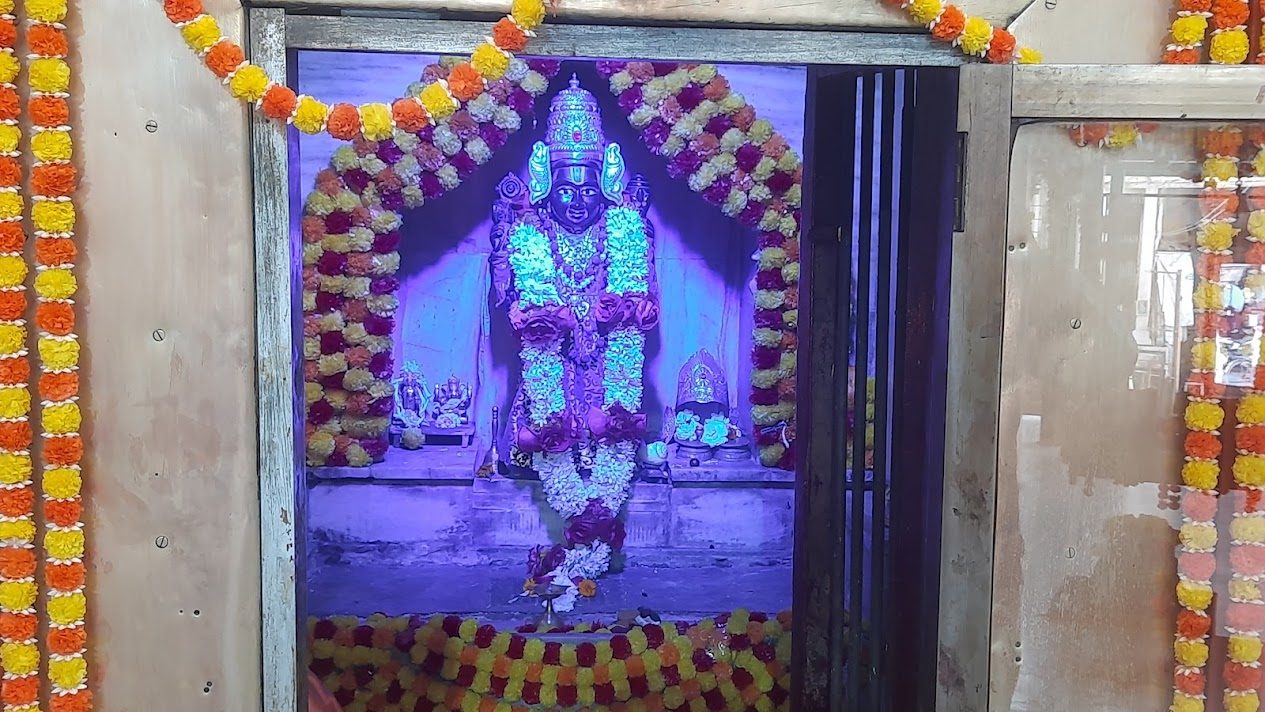
Location: Dange Galli, Manik Chowk, Ahilyanagar (Ahmednagar) | Connection: The great ascetic Rajaram Maharaj Dharmadhikari (samadhi 1840)
In most Datta temples we see an idol of Datta with three faces and six arms. But what was Datta's original, ancient form? Ancient texts and sculptures say that form was Ekmukhi (single-faced). Today only a handful of such Ekmukhi Datta idols remain in Maharashtra. One of them is in the old part of Ahilyanagar city, in Dange Galli near Manik Chowk. As you step in from the lane, the noise of the city falls behind, you see the carved teak pillars of the sanctum, and before you stands a Datta idol with a single, serene face. This idol was discovered by an ascetic saint through his inner vision, and that same saint's samadhi is in this very temple.
Story
The great ascetic Rajaram Maharaj Dharmadhikari
Some names are written in gold in the history of Ahilyanagar. One such radiant spiritual figure of the 18th and 19th centuries is the great ascetic Rajaram Maharaj Dharmadhikari. At a time when society stood on the threshold of change, Maharaj gave this region a spiritual direction through his devotion and wisdom. He was deeply spiritual and austere, and he commanded awe and respect as one of the most influential spiritual figures of his time.
A discovery through inner vision
This temple is not just a building but a symbol of Rajaram Maharaj's spiritual power. It was Maharaj who, through his inner vision, discovered this rare Ekmukhi Datta idol and installed it in this temple. At a time when the three-faced form of Datta had become customary everywhere, finding and installing a single-faced idol shows Maharaj's bond with the ancient tradition of Datta. Devotees believe it was ascetic saints who preserved such rare idols, and this tradition can be seen in Ahilyanagar too.
The cow that came at a wish
Devotees still reverently recount one sign of Maharaj's sadhana (spiritual practice). The moment Maharaj wished it in his mind, a cow would come to him. No words, no call, only the wish in his mind. This is regarded as a sign that even animals connect with a pure, compassionate mind, and that a seeker's peace reaches beyond words. In the image of Dattatreya, a cow is always by his side. That is why Datta devotees remember this episode from the saint's life with special feeling.
Influence on Ahilyanagar
Between about 1800 and 1840 CE, Maharaj's spirituality had a deep and far-reaching influence on the city of Ahilyanagar. It is an example of how one person's sadhana can change the spiritual atmosphere of an entire city.
Samadhi in this very building
In 1840 CE Maharaj took samadhi in this same sacred building. He came to rest in the presence of the very idol he had installed. That is why devotees feel that his presence can still be felt in every particle of this place. A saint's samadhi and a rare Ekmukhi Datta idol in the same building: this twofold combination is found in very few temples.
History
The single-faced form is the ancient form
A look at the history of Datta idols shows the importance of the single-faced form:
- In the description of idol-making in the Agni Purana, a Datta idol with one face and two arms is prescribed.
- A sculpture at Badami (10th–12th century CE) shows a single-faced Datta.
- Changdev Raul (1150–1220 CE) worshipped the single-faced Datta.
- Single-faced Datta idols are found in 15th-century temples of the Nath sampradaya.
- In the 16th century Dasopant worshipped a six-armed but single-faced form of Datta.
- After roughly 1000 to 1200 CE the three-faced form gradually became prevalent, and it became popular through the Gurucharitra and Sant Eknath's aarti ("Trigunatmak traimurti Datta ha jana" – know Datta as the three-in-one of the three gunas).
This shows that the single-faced Datta is regarded as older than the three-faced form, and as the original form. Today places of the Ekmukhi Datta are rare: Mahur (Datta Shikhar), Narayanpur (Purandar, Pune), Pandharpur, Bhalod and Rajghat on the banks of the Narmada, and Ahilyanagar. The Ahilyanagar temple is a living link to this rare tradition.
A jewel of architecture
As you enter the sanctum of the temple, you see the teak wooden pillars, about 200 years old. The carving on these pillars bears witness to the rich craftsmanship of that era. The strong, carved woodwork gives the temple a grandeur of its own.
Significance
- A rare Ekmukhi Datta idol that preserves the tradition of Datta's ancient form.
- The samadhi place of Rajaram Maharaj (1840).
- The temple is about 240 years old.
- The sanctum has carved teak pillars about 200 years old.
- A holy and revered place of faith in Ahilyanagar city.
The devotional meaning of "one face"
In the tradition of the Datta sampradaya, these meanings are given for the single-faced form (they are devotional meanings, not a scriptural definition):
- The Trimurti in one principle: Brahma, Vishnu and Mahesh are not three separate beings but the one Parabrahman. The three-faced form shows three functions, while the single-faced form shows all three merged into one root principle.
- The state beyond the gunas: the three faces stand for the gunas sattva, rajas and tamas; the Ekmukhi Datta is the Avadhoot state beyond all three gunas.
- One-pointed devotion: meditating before a single-faced idol means making the mind "single-faced", fixing it on a single goal.
- The Guru principle is one: though gurus may appear many, the Guru principle is one.
- Simplicity: a direct form without ornament; a direct, face-to-face relationship between devotee and God.
Festivals
Aarti is performed in the temple every day at 9:00 AM, and on Thursday, Datta's day, a special aarti is held at 8:00 PM. The Thursday night aarti is a weekly festival for the devotees here. In the Datta sampradaya, Datta Jayanti (Margashirsha Purnima), Guru Dwadashi (Ashwin Vadya Dwadashi) and Guru Purnima are special days for all Datta devotees.
Stories and lessons
| Story | Lesson |
|---|---|
| Rajaram Maharaj discovered the rare Ekmukhi Datta idol through inner vision and installed it | Insight born of sadhana shows the way. Ekmukhi Datta means the Trimurti in one principle, that is, one-pointed devotion. |
| The moment Maharaj wished it in his mind, a cow would come to him | Even animals connect with a pure mind. Compassion and peace reach beyond words. |
| Between 1800 and 1840 he gave Ahilyanagar a spiritual direction | One person's sadhana can change the atmosphere of an entire city. |
| He took samadhi in this very temple | The presence of saints remains in a place. That is why the temple is not just a building but a living place of faith. |
| The 200-year-old carved teak pillars still stand today | Work done with faith lasts for generations. |
Darshan
- Address: Ekmukhi Datta Mandir, Dange Galli, Manik Chowk, Ahilyanagar
- Darshan hours: 7:00 AM to 9:00 PM
- Aarti: daily at 9:00 AM and every Thursday at 8:00 PM
If you wish to see Datta's original, ancient single-faced form, and to sit quietly for a few moments before the samadhi of an ascetic saint, do visit this temple in Dange Galli. Shri Gurudev Datta!