
Gokarna Mahabaleshwar, Karnataka
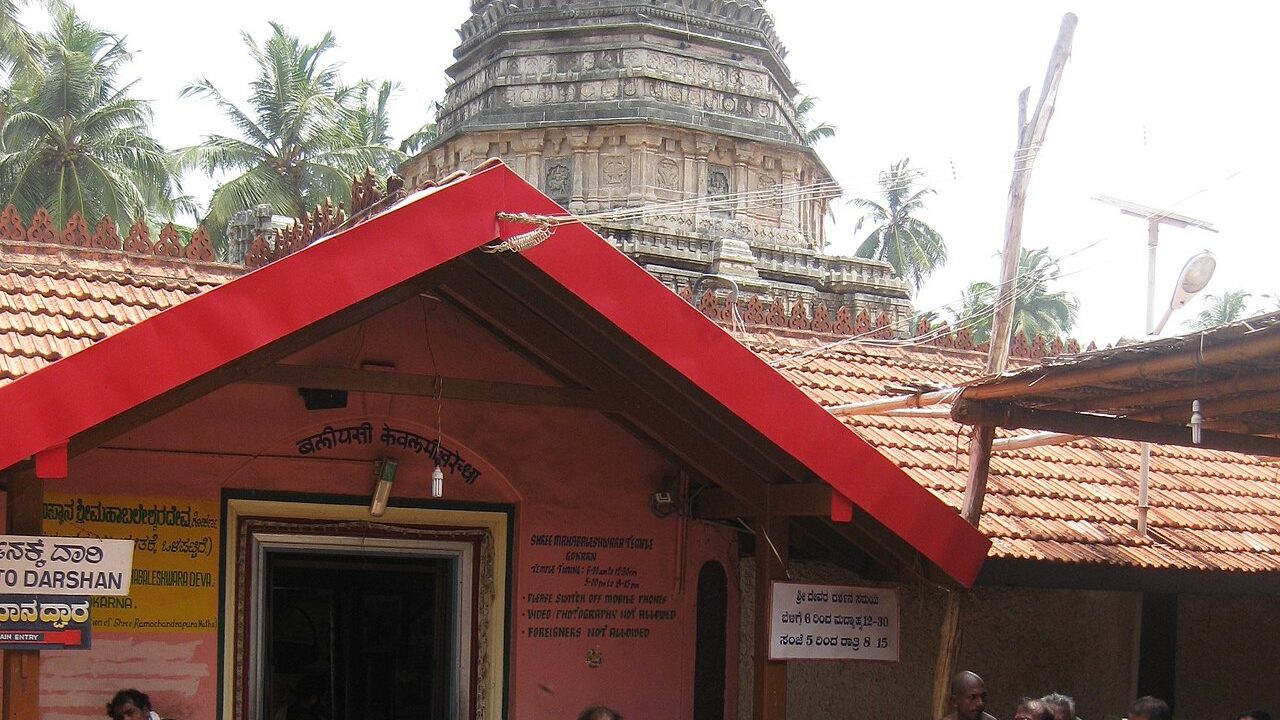
Location: Uttara Kannada district, Karnataka (on the Arabian Sea coast) | Connection: Stay of Shripad Shrivallabh; Gurucharitra Ch. 6–7
Evening. The sun is setting over the sea. A mighty one like Ravana stands holding Shankar's Atmalinga in his hands, and it is time for his evening prayers (sandhya). The condition is that the linga must not be set down on the ground. A little cowherd boy appears before him. In the next few moments something happens that defeats all of Ravana's strength, and the place gets its name: Gokarna. Why did Shripad Shrivallabh, returning from all the tirthas of the north, choose this very kshetra to stay for three years? The answer lies in these stories.
The story
The installation of the Atmalinga (Ch. 6)
The mother of Ravana, king of Lanka, worshipped Shiva every day. Seeing her devotion, Ravana resolved, "I will bring Shankar's very Atmalinga to Lanka." He went to Kailas and began severe penance. According to tradition, the account of this fierce tapas says he offered up his heads and, making a veena of his own body, sang the Sama hymns.
Shankar was pleased, and Ravana asked for the Atmalinga. Not refusing his devotee, Shankar gave it, but with one condition: "Do not set this linga down on the ground anywhere on the way. Once it is placed on the ground, it will remain fixed there forever."
If the Atmalinga reached Lanka, Ravana would become invincible and torment the three worlds. Fearing this, Indra and the other gods were distressed. They ran to Shri Vishnu. Vishnu suggested a plan and entrusted the task to Shri Ganesh, the giver of wisdom.
Ravana set out south with the linga. When he reached the seashore near Gokarna, evening fell. (According to tradition, Vishnu covered the sun with his discus to create the illusion of evening.) Ravana was strict in his daily observances; he could not miss his sandhya. But he could not put down the linga in his hands.
Just then Ganesh came there in the form of a young Brahmin boy (a cowherd). Ravana called him: "Hold this linga until I finish my sandhya. Whatever happens, do not set it down." The boy said, "It is very heavy. I will call you three times. If you do not come, I will put it down."
As soon as Ravana sat for sandhya, Ganesh called three times and set the linga down before Ravana could return. The linga took root there at once. Ravana came running and tried with all his might to pull it out. But the linga did not move; it only got twisted into the shape of a cow's ear. So the place came to be called "Gokarna" (cow's ear), and the linga that did not move even for a mighty one like Ravana came to be called "Mahabaleshwar". Tradition also tells that the enraged Ravana struck the boy-Ganesh on the head. At last, disheartened, he returned to Lanka, and gods, sages and tirthas came to dwell there.
The liberation of King Mitrasaha (Ch. 7)
In the Solar dynasty there was a valiant king named Mitrasaha. While hunting he killed a rakshasa. To take revenge, the rakshasa's brother entered the king's service disguised as a cook. Once, when the family Guru Sage Vasishtha came for a meal at a shraddha, the treacherous cook served human flesh on his leaf-plate. In anger Vasishtha cursed the king: "You will become a brahmarakshasa."
The king was innocent. He took water in his hand to curse back, but Queen Madayanti stopped him from cursing his Guru. He poured that cursing water on his own feet, and his feet turned black; so he came to be called Kalmashapada. When Vasishtha learned the truth, he limited the curse to twelve years.
As a brahmarakshasa, the king devoured a Brahmin in the forest. After twelve years he regained his former form, but the sin of killing a Brahmin pursued him like a terrible shape. Despite many tirthas and penances, it would not leave him. Wandering, he came to Mithila and fell at the feet of Sage Gautama. Gautama said, "Gokarna destroys all sins. Worship Mahabaleshwar there." And to give him faith, he told him of an incident.
The salvation of the chandala woman (Ch. 7)
Once, when Gautama was at Gokarna, a chandala woman was wandering there. She was old, sick, blind and tormented by hunger. It was the day of Shivaratri. As she begged pilgrims for food, someone placed a bel leaf in her hand. Since it was not something to eat she threw it away, and without her knowing it fell on the Shivalinga. Because she got no food that day, she also ended up fasting, and hunger kept her awake all night in vigil.
The next day she left her body, and Shiva's attendants (Shivaganas) came with a divine chariot and took her to Kailas. Astonished, Gautama asked the reason. The Shivaganas said, "This is the fruit of the fast, the night vigil and the offering of bel that happened unknowingly at Gokarna on Shivaratri."
Hearing this story, Mitrasaha went to Gokarna, bathed, and worshipped Mahabaleshwar with faith. His sin was destroyed and he once again ruled according to dharma.
Shripad's stay at Gokarna
After his pilgrimage to the tirthas of the north, Shripad Shrivallabh came to Gokarna, and according to the Gurucharitra he lived here in secret for three years. Siddhamuni tells Namdharak, "This kshetra is like Kailas itself. That is why Shripad lived there." From here he went on to Kuravapur on the banks of the Krishna.
History
- Gokarna has been a famous Shiva kshetra since ancient times. It is mentioned as a tirtha in the Puranas and in the Mahabharata too.
- In the Gurucharitra, chapters 6 and 7 are devoted entirely to the glory of Gokarna. Siddhamuni tells this glory on the occasion of Shripad's stay.
- At the Mahabaleshwar temple, the custom is to have darshan of the Atmalinga through an opening in the shalunka (the base of the linga).
Significance
- According to the Gurucharitra, Shripad Shrivallabh lived here for three years.
- It is regarded as "Bhukailas" (Kailas on earth): a supreme Shiva kshetra for washing away sins.
- A Datta avatar staying in a Shiva kshetra is a symbol of the unity of Hari and Hara.
- Did you know? Devotees say the Mahaganapati here bears the mark of Ravana's blow on his head.
Stories and lessons
| Story | Lesson |
|---|---|
| Ganapati had the Atmalinga set down at Gokarna by Ravana (Ch. 6) | Wisdom is greater than strength. Power gained through ego does not last. The right strategy at the right time protects dharma. |
| King Mitrasaha: Queen Madayanti stopped him from cursing; later, on Sage Gautama's advice, he was freed at Gokarna (Ch. 7) | A companion who restrains your anger is a blessing. Even after a grave sin, repentance and the advice of a true Guru open the way to liberation. |
| The bel leaves the chandala woman threw fell unknowingly on the Shivalinga and she attained salvation (Ch. 7) | God's grace is not limited to any caste or condition. Even a small good deed done at a holy place at a holy time bears great fruit. |
Festivals
- Mahashivaratri: Gokarna's biggest festival, with a chariot festival, all-night puja and vigil. The story of the chandala woman is linked to this very day.
- Special Shiva puja is also held here in the months of Shravan and Kartik.
- Many devotees also come to Gokarna for rites for the ancestors.
Darshan information
- Gokarna is in the Uttara Kannada district of Karnataka, on the Arabian Sea coast. The nearest railway station is Gokarna Road (Konkan Railway); Kumta is the nearest town.
- Gokarna can be reached by road from Goa and Hubli.
- By custom, devotees first bathe in the sea / Kotitirtha, then have darshan of Mahaganapati, and then of Mahabaleshwar.
Places to visit
- Mahabaleshwar temple (Atmalinga)
- Mahaganapati temple
- Kotitirtha