
Audumbar, Maharashtra
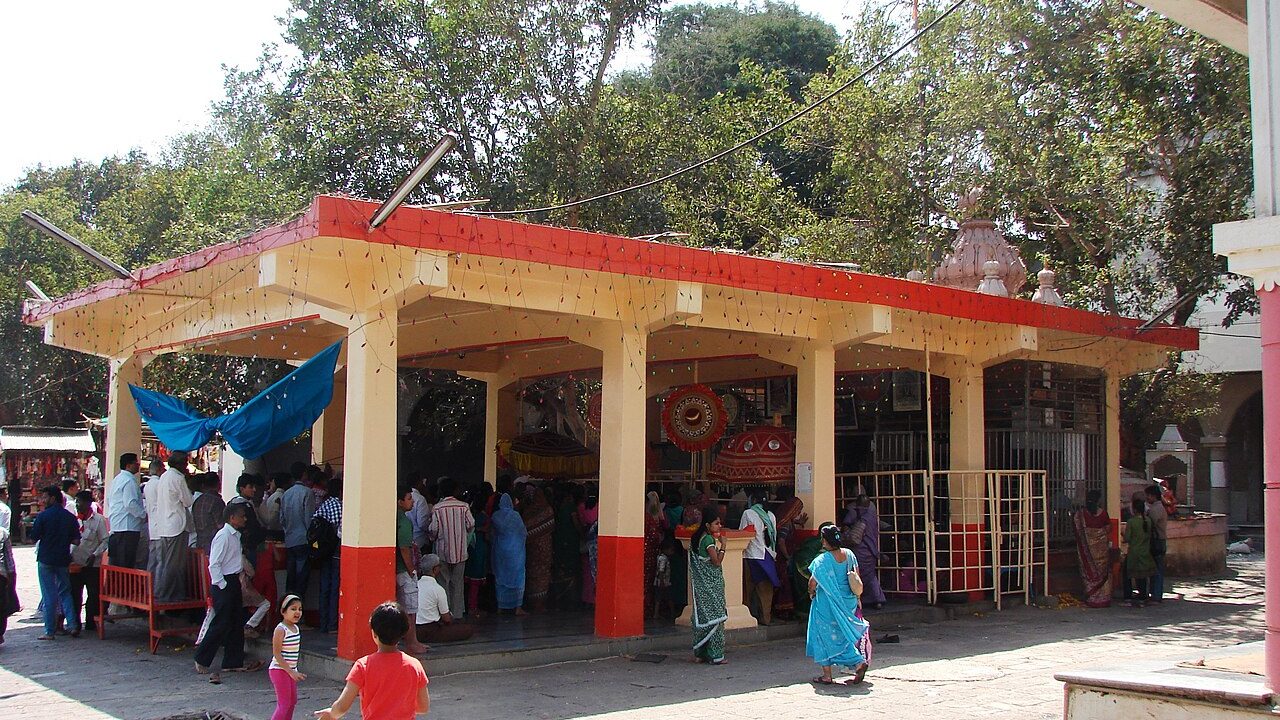
Location: Sangli district (near Bhilawadi, on the Krishna) | Connection: Chaturmas of Shri Nrusinha Saraswati (Ch. 16–17)
Everyone mocks a young man as an "ox". He is the son of a learned father, yet he cannot recite even a single Vedic mantra. Burning with humiliation, he goes to a Devi temple, sits there fasting for three days, and then takes a step so extreme that it makes the listener shudder: he cuts off his own tongue and offers it to the Devi. That night the Devi appears in his dream and says, "Go across the river, under the audumbar tree." The village on that far bank of the Krishna is Audumbar, where Shri Nrusinha Saraswati spent one chaturmas (the four months of the rainy season).
The story
The teaching on devotion to the Guru (Ch. 16)
After his hidden stay at Parli Vaijnath, Shri Guru came to Bhilawadi on the banks of the Krishna river. The shrine of Bhuvaneshwari Devi is there. One day a tired, restless Brahmin came there, fell at Shri Guru's feet and began to weep. "Swami, I want knowledge, I want peace of mind. I served one Guru and found no fulfilment. Then I went to another, and a third. Now I do not know who the true Guru is."
Shri Guru smiled and said, "Child, the fault is not the Gurus'; it is your mind's. One whose mind is full of doubt gets knowledge from no Guru. The Guru is one. If you serve him with firm faith, regarding him as God, knowledge reveals itself on its own." And he told him the story of the three disciples of Sage Dhaumya.
The first disciple was Aruni. In a heavy downpour, the embankment of the Guru's field began to break. Dhaumya sent him to stop the water. Even after piling earth, the water would not stop, so Aruni lay down across the breach himself and held back the water all night. In the morning, as soon as Dhaumya called, he rose and came. By the blessing of the pleased Guru all knowledge arose in him, and because he rose up out of the embankment he got the name Uddalaka.
The second disciple was Upamanyu. His task was to tend the cows. One by one the Guru stopped his bhiksha (alms), the second bhiksha he begged, the cows' milk, even the froth from the calves' mouths. Faint with hunger, he ate the leaves of the rui (calotropis) plant, lost his sight, and fell into a well. The Guru told him to sing the praises of the Ashvini Kumars. They appeared and offered him food, but Upamanyu said, "I will not eat without first offering it to my Guru." By his steadfastness he received his sight and all knowledge.
The third disciple was Bida. He laboured like an ox in the Guru's house, bore cold and heat, hunger and thirst, but never complained. By the Guru's grace he too became wise.
Ending the story, Shri Guru said, "If there is such service, one need not wander in search of a Guru. The Guru himself comes looking for the disciple." The Brahmin's eyes were opened. Shri Guru placed his hand on his head, his doubts vanished, and he became a single-minded devotee of the Guru.
The dull-witted Brahmin becomes learned (Ch. 17)
On the bank opposite Bhilawadi, at Audumbar, Shri Guru spent a chaturmas under an audumbar (udumbara fig) tree. It was during this time that this incident took place.
In the city of Karveer (Kolhapur), the only son of a learned Brahmin had been dull-witted from birth. His father taught him a great deal, but he could not memorise even one Vedic mantra. The father died in grief. Then the boy's troubles grew. People said, "The son of such a scholar, and he does not know a single letter. He is just like an ox." No one invited him to Brahmin rites. Unable to bear the humiliation, he left home.
Wandering, he came to the temple of Bhuvaneshwari Devi at Bhilawadi. Saying, "Mother, give me learning, or I will give up my life right here," he began to fast. Three days passed and nothing happened. In a fit of despair he said, "What use is a tongue that cannot recite the Vedas?" And he cut off his tongue and offered it at the Devi's feet.
That night the Devi appeared to him in a dream. "Child, I know your sorrow. But the one who will give you learning is someone else. Across the river, under the audumbar tree, an ascetic is doing tapas. He is Shri Nrusinha Saraswati, the avatar of the Trimurti. Take refuge in him."
In the morning he rose. Without a tongue he could not speak, but hope had awakened in his heart. He crossed the Krishna and, with tears, laid his anguish at the feet of Shri Guru, who sat in meditation under the audumbar. Shri Guru compassionately placed his hand on his head. His tongue was restored, the darkness over his mind vanished, and in an instant he became expert in the Vedas, shastras, grammar, logic and Puranas. When he returned to his village, those who had mocked him were astonished.
After this incident the fame of Audumbar and of Shri Guru spread far and wide. When the chaturmas ended, Shri Guru went on along the Krishna to Amarapur (today's Narsobawadi).
The glory of the audumbar tree (Ch. 19)
Why did Shri Guru always stay under an audumbar tree? The Gurucharitra explains: after slaying Hiranyakashipu, Lord Narasimha's claws began to burn terribly from the demon's poison. Goddess Lakshmi brought audumbar fruits and had him plunge his claws into them, and the burning subsided. Pleased, Narasimha gave the audumbar a boon: "You will be as fruitful as the wish-fulfilling tree (kalpavriksha), and my presence will always remain near you." So Shri Guru, who bore Narasimha's name, stayed under the audumbar. It is believed that this village also took its name from that tree.
Significance
- Shri Guru spent one chaturmas here.
- The audumbar (umbar) is Datta's beloved tree. After the Narasimha avatar killed Hiranyakashipu, the burning of the claws was soothed by the audumbar, so it is regarded as equal to the kalpavriksha.
- Devotees come here for learning and growth of intellect. The 17th chapter of the Gurucharitra is considered especially meaningful here for students.
- Did you know? In this one story the Devi (Bhuvaneshwari) does not grant the devotee a boon herself but sends him to the Guru. The Gurucharitra's central message, "knowledge needs a Guru", is plain to see in this episode.
History
- Audumbar is a small, scenic village on the Krishna in Sangli district. On the opposite bank is Bhilawadi with its temple of Bhuvaneshwari Devi.
- In memory of Shri Guru's stay, a temple of the Vimal Padukas stands here.
- In later times Datta-devotee saints such as Brahmanand Swami lived here, and his math still stands here.
Stories and lessons
| Story | Lesson |
|---|---|
| Teaching to the Brahmin who had wandered among many Gurus (Ch. 16) | One Guru, one faith. Rather than searching here and there, fruit comes only from firm faith in one. |
| Aruni lay across the breach himself; Upamanyu stayed obedient even while starving (Ch. 16) | Obedience and sacrifice. Serve the Guru not only when it is convenient, but also when it is hard. |
| The dull-witted Brahmin offered his tongue and became learned at Shri Guru's touch (Ch. 17) | Humiliation is not the end. With intense longing, grace surely comes. But the Devi sent him to the Guru: in the end, knowledge needs a Guru. |
| The audumbar soothed the burning of Narasimha's claws (Ch. 19) | Coolness is strength. One who soothes another's burning becomes dear even to God. |
Festivals
- Datta Jayanti (Margashirsha Purnima): the main festival here.
- Guru Pratipada (Magh Vadya Pratipada) and Shri Nrusinha Saraswati Jayanti (Paush Shuddha Dwitiya).
- During chaturmas many devotees do Gurucharitra parayan and circumambulation of the audumbar tree here.
Darshan information
- Audumbar is in Sangli district, on the Krishna north of Sangli city. The nearest railway station is Bhilawadi (Pune–Miraj line); Miraj is the large junction.
- From the Bhuvaneshwari temple at Bhilawadi you can see Audumbar across the river. Both places can be visited in one day.
- Narsobawadi, the next Datta kshetra, is close by on the same bank of the Krishna, so devotees usually combine the Audumbar–Narsobawadi pilgrimage.
Places to visit
- Shri Nrusinha Saraswati temple and the Vimal Padukas
- Bhuvaneshwari Devi, Bhilawadi (across the river)
- Brahmanand Swami math