
Narsobawadi (Nrusinhawadi), Maharashtra
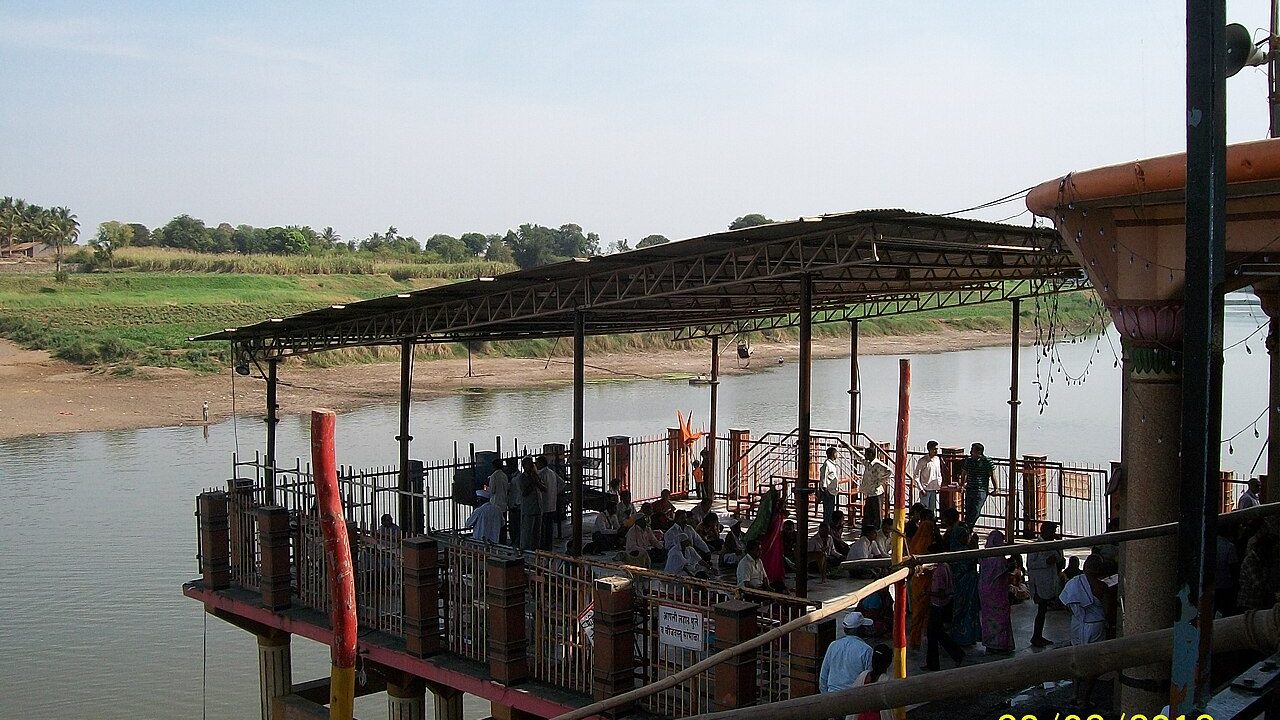
Location: Shirol taluka, Kolhapur district (Krishna–Panchganga sangam) | Connection: Shri Nrusinha Saraswati's 12-year stay
At the door of a poor house grows a single vine, and the whole family lives on its beans. A sannyasi eats a meal in that house, and as he leaves he pulls that very vine out by the roots! The woman of the house cries out, "Our only support is gone!" But in the next few hours something happens that frees the family from poverty forever. This story took place at the confluence of the Krishna and the Panchganga, where Narsobawadi stands today.
The story
The bean vine and the pot of gold (Ch. 18)
After completing the chaturmas at Audumbar, Shri Guru came along the banks of the Krishna to near the Krishna–Panchganga sangam. This area was called Amarapur; the temple of Amareshwar and many tirthas are here. Shri Guru did tapas at the sangam by day and went into the village for bhiksha (alms) at midday.
In Amarapur lived a poor but learned Brahmin with his wife and children. He ran his household by begging madhukari (alms of cooked food). At his door grew a ghevda (pavta) bean vine. On days when no alms came, the family filled their stomachs with a vegetable made from its pods.
One day Shri Guru came to that very house for bhiksha. There was nothing else in the house, so the Brahmin's wife lovingly served the bean vegetable. Shri Guru accepted it with joy. And as he left, without a word, he pulled the vine at the door out by its roots and went off towards the sangam.
The wife was shaken. "What kind of sannyasi is this? We gave him alms with devotion, and he has uprooted our only support! What will we feed the children now?" The Brahmin, however, was calm. "Do not speak like that. He is Shri Guru himself. Whatever he has done is for our good." Saying this, he began to dig the ground to remove the remaining root.
As he dug, his pickaxe struck something hard. Clearing away the earth, he found a pot, and it was full of gold coins! Uprooting the vine meant uprooting their poverty. The two ran to the sangam. The wife asked forgiveness for her bitter words. Shri Guru smiled and said, "This wealth is your good fortune. But do not tell anyone about it. Use it according to dharma. Poverty will not come into your family line."
The 64 Yoginis and Ganganuj (Ch. 19)
The villagers found one thing strange: sometimes this sannyasi did not come for bhiksha, yet he never seemed hungry. The secret was that every day at midday sixty-four Yoginis came out of the Krishna. Bowing to Shri Guru, they took him through the water to their divine abode, worshipped him, offered him bhiksha and brought him back to the audumbar tree.
A simple farmer named Ganganuj, whose field was on the riverbank, was astonished to see this one afternoon. The next day he hid and watched, and then, gathering courage, followed them into the water. Inside he saw a golden city, where the Yoginis had seated Shri Guru on a throne and were worshipping him. Shri Guru asked, "How did you get here? What do you want?" Ganganuj folded his hands and said, "Swami, I am poor. Please uplift me." Shri Guru blessed him and warned him not to tell anyone this secret. Later he found hidden treasure in his field, and he became a faithful servant who came for darshan every day.
According to the traditional text, when Ganganuj expressed a wish to go on pilgrimage one Maghi Purnima, Shri Guru gave him darshan of Prayag, Kashi and Gaya in a single day and brought him back.
The Manohar Padukas
After some time Shri Guru decided to go to Ganagapur on the Bhima–Amarja sangam. The Yoginis and devotees were distraught. Shri Guru assured them, "I will always remain here in hidden form. My presence is under this audumbar." There he installed his Manohar Padukas. The Yoginis too stayed on there.
The mother from Shirol (Ch. 20–21)
The truth of this promise was felt after Shri Guru had left. The children of the wife of a Brahmin named Gangadhar, from the nearby village of Shirol, kept dying in infancy. Those who knew said that in a previous life she had cheated a Brahmin of the Shaunak gotra of his money, and his restless spirit (samandh) was pursuing her. She came to Amarapur and began serving the audumbar. When the spirit attacked her in a dream, Shri Guru appeared, rebuked it, settled the debt and liberated it too. She had two sons.
But the younger son fell ill and died before his choul (first haircut ceremony). Crying, "Has the Guru's word proved false?", the mother tied the body to her back, came to the padukas under the audumbar and kept beating her head against them. After midnight, in a dream, a radiant ascetic applied ash to the baby's forehead. When she woke, the child had opened his eyes and was saying, "Mother, I'm hungry." This is the famous testimony at the Wadi that the Guru's word never proves false.
Stories and lessons
| Story | Lesson |
|---|---|
| The bean vine was uprooted and a pot of gold was found (Ch. 18) | Even when the Guru's action seems harsh on the surface, it holds our welfare. The Brahmin kept his patience, so he got the fruit. Only when the support we cling to is let go does something greater come. |
| Shri Guru lovingly accepted a poor home's simple bean vegetable (Ch. 18) | God loves the feeling, not the food. |
| Ganganuj began out of curiosity and became a devotee (Ch. 19) | Curiosity is the first step of devotion. Even an ordinary person who comes into satsang becomes worthy of grace. |
| On leaving, he placed the Manohar Padukas and promised, "I am always here" (Ch. 19) | Even when the Guru leaves in body, he remains in principle. A place's sanctity is kept alive by faith. |
| The Shirol mother's dead baby came back to life at the padukas (Ch. 20–21) | Faith is tested, but the Guru's word never fails. Even if one blames God in grief, the Guru does not abandon the devotee. |
History
- The "Amarapur" of the Gurucharitra is the area of today's Nrusinhawadi. After Shri Guru's name the village came to be called Nrusinhawadi, or in popular speech Narsobachi Wadi.
- The temple of the Manohar Padukas is on the bank of the sangam, and in the monsoon it is often submerged by floodwater.
- In later times great Datta devotees such as Shri Narayan Swami and Shri Vasudevanand Saraswati (Tembe Swami) did sadhana here. Tembe Swami is regarded as a major contributor to the Wadi's system of worship.
Significance
- Shri Guru lived here for 12 years. When leaving for Ganagapur he installed the Manohar Padukas and said, "I am always here."
- The largest and most spiritually awake (jagrut) Datta kshetra in Maharashtra.
- The Dakshinadwar ceremony: in the monsoon the water of the Krishna touches the padukas in the sanctum and flows out through the southern door. This is regarded as a holy bathing occasion.
- The daily worship routine here (palkhi, devotional songs, dhuparti) is held up as a model for many Datta temples.
- Did you know? At the time of the Dakshinadwar ceremony thousands of devotees bathe in the Krishna's floodwater; the feeling behind it is that the river itself performs abhishek on Shri Guru's padukas.
Festivals
- Datta Jayanti (Margashirsha Purnima): the biggest festival here.
- Guru Dwadashi (Ashwin Vadya Dwadashi) and Guru Pratipada (Magh Vadya Pratipada).
- Shri Nrusinha Saraswati Jayanti (Paush Shuddha Dwitiya).
- Dakshinadwar ceremony: in the monsoon, whenever floodwater enters the sanctum.
- A palkhi ceremony is held every night.
Darshan information
- Narsobawadi is in Shirol taluka of Kolhapur district. The nearest railway station is Jaysingpur, and the large junction is Miraj.
- There are regular bus services from Sangli, Miraj and Kolhapur.
- Audumbar, a nearby Datta kshetra, is on the same bank of the Krishna, so both darshans can be combined.
Places to visit
- Manohar Paduka temple (on the sangam bank)
- Memorials of saints such as Narayan Swami and Tembe Swami
- Amarapur (Amareshwar) and the 64 Yoginis shrine