Mahur (Matapur), Maharashtra
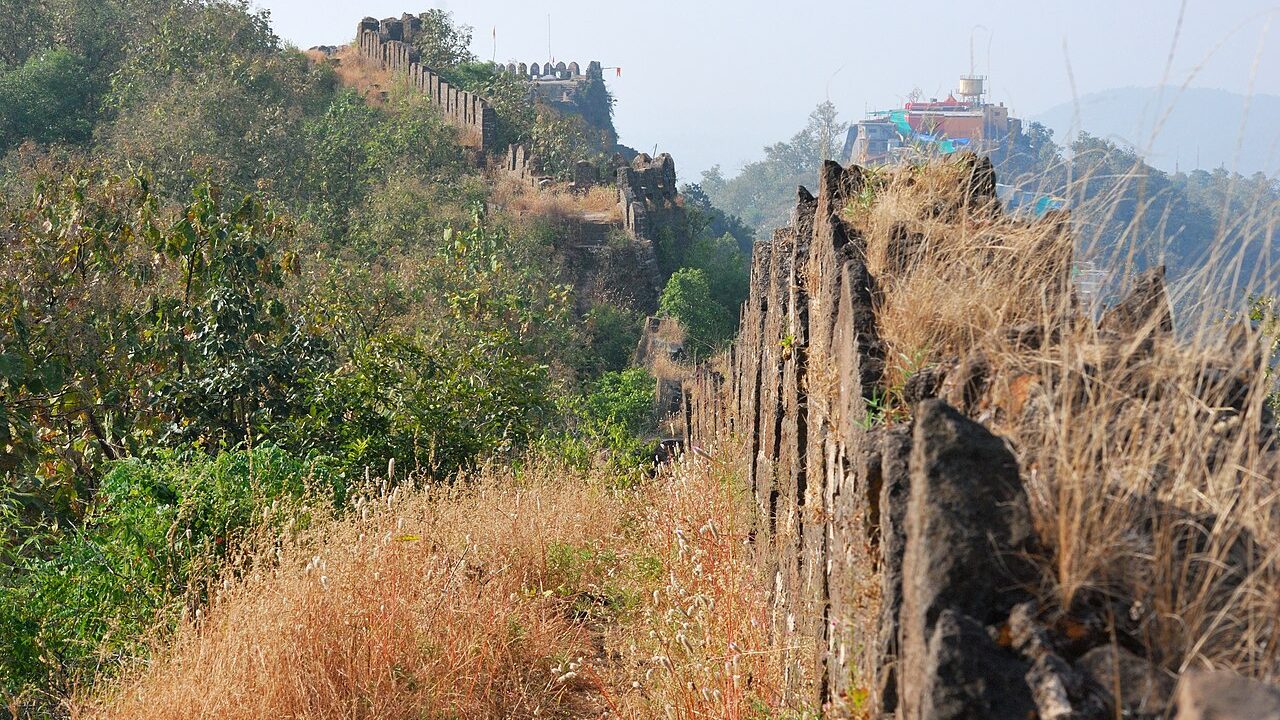
Location: Nanded district, on the Marathwada–Vidarbha border | Connection: Datta's resting place; Atri–Anasuya ashram tradition
Dattatreya runs to answer his devotees' calls all day long, so where does he rest at night? The tradition of Datta devotees answers by naming a hill town: Mahur. Far from the Sahyadris, set on the green hills around the Painganga, this kshetra is known for three things at once: it is the birthplace and the resting place of Shri Dattatreya, and it is the seat of Shri Renuka Mata, one of the three and a half Shakti Peethas. Mother Anasuya on one hill, the child Datta on another, and Renuka Mata on a third: it is a meeting place of motherhood and guruhood.
Story
Datta's resting place
The traditional saying of the Datta Sampradaya, "Matulingapure nidra", is understood by tradition to mean that Dattatreya sleeps every night at Mahur (Matapur). Folk tradition describes Datta's daily routine like this: bath at Kashi, bhiksha (alms) at Kolhapur, meal at Panchaleshwar and sleep at Mahur. That is why Datta devotees regard Mahur as Datta's "place of rest".
Atri–Anasuya and the birth of Datta (Ch. 4)
On the hill at Mahur stands the place of Atri and Anasuya, and tradition holds that Dattatreya was born here. The story in the fourth chapter of the Shri Gurucharitra goes like this.
Anasuya, wife of the sage Atri, was a great pativrata (a wife wholly devoted to her husband). Her very name means "one without envy". Indra and the other gods began to fear that the radiance of her devotion would cost them their positions. They went to Brahma, Vishnu and Mahesh. The Trimurti decided to test Anasuya's virtue.
While the sage Atri had gone to the river for his rituals, the three came to the ashram disguised as Brahmin guests. Anasuya welcomed them gladly and prepared a meal. Then they said, "We want food, but on one condition. You must serve us the bhiksha unclothed. Otherwise we will go back hungry."
Anasuya stood still for a moment. On one side, sending a guest away was adharma; on the other was the question of her devotion to her husband. She realised in her heart, "These are not ordinary guests. This is a test of my virtue." She took the padodak (water that had washed her husband's feet) of the sage Atri and sprinkled it on the three guests. At that very moment all three became newborn babies. Now the condition posed no difficulty at all. With a mother's love Anasuya nursed the babies, laid them in a cradle and sang them a lullaby.
Meanwhile, as their husbands did not return, Savitri, Lakshmi and Parvati grew anxious, came to Atri's ashram and asked for their husbands back. At her husband's command Anasuya restored the Trimurti to their original forms. Pleased, the Trimurti said, "Ask for a boon." Anasuya asked, "May the three of you be born from my womb as my sons." Accordingly Chandra was born from a portion of Brahma, Dattatreya from a portion of Vishnu and Durvasa from a portion of Shankar. Later Chandra and Durvasa placed their portions in Dattatreya. "Datta" because he gave himself, "Atreya" as the son of Atri: Dattatreya.
Parashurama and Renuka Mata
Mahur's second story comes from the Puranic tradition, and it is told in different versions. The tradition current in Mahur says that, greedy for Kamadhenu (the wish-fulfilling cow), the sons of Sahasrarjuna (Kartavirya Arjuna) attacked the ashram of the sage Jamadagni. Jamadagni was killed and Mother Renuka went with him as a sati. When Parashurama returned and saw the bodies of his parents, he was overcome with grief. Carrying both bodies in a kavad (a shoulder pole), he wandered in search of sacred ground for their last rites. It is believed that Dattatreya then guided him to Mahur and performed the last rites himself as the officiating priest. The place where Parashurama performed these rites is known as Matrutirtha. Devotees say that as Parashurama grieved for his mother, Renuka Mata emerged from the earth before him, but only in the form of her face. That is why at Mahur Renuka's face (tandla) is worshipped.
According to another well-known Puranic story, at the command of his father Jamadagni, Parashurama beheaded his mother, and later brought her back to life through a boon from his father. The details of the stories differ, but the tradition in Mahur agrees on one thing: Dattatreya showed the grieving Parashurama the way here. So Mahur is both a Renuka Shakti Peetha and a Datta kshetra. According to tradition, the teaching of self-knowledge that Dattatreya later gave Parashurama is known as the "Tripura Rahasya".
The devoted wife of Mahur (Ch. 30–32)
Mahur's name appears in another story of the Shri Gurucharitra. A Brahmin named Gopinath of Mahur, after losing many children, had a son. He was married at twelve, but at sixteen he fell victim to an incurable illness, which later became tuberculosis. Many remedies were tried, but none helped. Someone said, "Shri Guru is in Ganagapur; by his darshan even incurable illnesses are cured." His wife set out on the hard journey with her sick husband. But as soon as they reached Ganagapur, before they could have Shri Guru's darshan, her husband died.
She clung to the body and wept aloud. Then a radiant brahmachari (young celibate ascetic) came and taught her about the perishability of the body. When she resolved to follow her husband in death, the brahmachari said, "First have Shri Guru's darshan at the sangam." She ran there and laid her head at Shri Guru's feet. Seeing the kumkum on her forehead and the bangles on her wrists, Shri Guru blessed her spontaneously: "Saubhagyavati bhava! Ashtaputra bhava!" (May you always be a wife whose husband lives! May you have eight sons!) (In devotional tradition this blessing is famous as "Akhanda saubhagyavati bhava".)
The people were stunned. "Swami, her husband is dead." Shri Guru said, "Our word never proves false. Bring the body here." He sprinkled water consecrated with the Rudra Sukta and akshata (consecrated rice) on the body, and before everyone's eyes the husband sat up as if waking from sleep. Only then did she learn that the brahmachari who had sent her for darshan was Shri Guru himself. Shri Guru said that thirty years of life from his next birth had been given to him in this one.
History
Mahur is an ancient pilgrimage place set among hill ranges in Nanded district, on the border of Vidarbha. The fort of Mahurgad is also here. Separate temples stand on several hills: Datta Shikhar, the Atri–Anasuya Shikhar and the Renuka Mata Mandir. The Datta idol on Datta Shikhar is said to be Ekmukhi (single-faced), which is why Mahur is named in the ancient tradition of the Ekmukhi Datta. Mahur also holds a special place in the Nath and Mahanubhav traditions.
Did you know? Of the three and a half Shakti Peethas, Kolhapur, Tuljapur and Mahur are considered the three full peethas, and the Saptashrungi of Vani the half peetha. So both Datta's place of alms (Kolhapur) and his place of sleep (Mahur) are also Shakti Peethas.
Significance
- The kshetra of sleep in Datta's daily routine.
- Renuka Mata is one of the full peethas among the three and a half Shakti Peethas.
- Regarded as Dattatreya's birthplace and original seat. Mahur is also important in the Nath and Mahanubhav traditions.
- A place in the ancient tradition of the Ekmukhi Datta.
Festivals
- Datta Jayanti (Margashirsha Purnima): a large yatra (pilgrim fair) gathers on Datta Shikhar. As this is considered Datta's birthplace, it is the biggest Datta festival here.
- Navratri (Ashwin) and Vijayadashami: a big festival at the Renuka Mata Mandir.
- On Guru Purnima and every Thursday, devotees crowd Datta Shikhar.
Stories and lessons
| Story | Lesson |
|---|---|
| Anasuya answered the Trimurti's test with a mother's love (Ch. 4) | Purity and love are the greatest power. In hard moments, wisdom and a mother's heart find the way. |
| Datta guided Parashurama, who was unsure where to perform his parents' last rites | In moments of grief and confusion, the Guru gives direction. Even a warrior drowning in sorrow finds peace only through the Guru's guidance. |
| Datta's daily resting place | Service all day, peace at night. A balance of work and rest is Datta's very routine. |
| The devoted wife of Mahur received the blessing "Saubhagyavati bhava" (Ch. 32) | The Guru's word never proves false. Do not give up faith even at the edge of despair. |
Darshan information
A pilgrimage to Mahur is a pilgrimage of hills. Datta Shikhar, Anasuya Shikhar and the Renuka Mata Mandir are on different hills, so there are steps to climb; start early in the morning. Datta Jayanti and Navratri draw large crowds. Mahur is connected by road to the city of Nanded.
Places to see
- Datta Shikhar (Datta temple)
- Atri–Anasuya Shikhar
- Renuka Mata Mandir
- Mahurgad fort
- Matrutirtha